

05 Aug What Forty-Four Years as a Fiduciary Taught Me About the Compounding of Wealth
A personal reflection on markets, judgment, humility, and the responsibilities of a financial advisor
Ram Kolluri, CFP® Exponential Wealth Management, LLC | Austin, Texas
I entered the investment profession in 1980, shortly after completing an MBA in finance. I earned the Certified Financial Planner designation in 1982 and established an independent registered investment advisory firm later that year.
At the time, I believed I was well educated. I understood financial statements, security analysis, asset allocation, economics, and the mathematical foundations of finance. Yet, as I now look back over more than four decades as a fiduciary advisor, I recognize that formal education had given me many of the individual pieces of the puzzle without necessarily showing me how those pieces should be assembled over the lifetime of a family.
Some of the most important principles of wealth management were not learned in a classroom. They were learned by sitting beside clients during recessions, market crashes, inflationary periods, speculative booms, family transitions, retirements, illnesses, and the deaths of spouses.
They were learned through observation, experience, and — most importantly — reflection.
This article is not intended as a marketing piece. Nor is it an argument that one advisor, investment philosophy, or portfolio construction method possesses all the answers. It is an attempt to record for future investors and advisors some of the hard truths that became clearer to me only after decades of practice.
I have been fortunate to sit in the front row of an extraordinary period in the history of American capitalism. During approximately the same span as my career, the S&P 500 became one of the most powerful and accessible engines of long-term wealth creation available to ordinary investors.
The lesson, however, is not simply that stocks went up.
The more profound lesson is that time, ownership, reinvestment, low costs, tax awareness, and disciplined behavior worked together to produce results that few investors — or advisors — could have fully appreciated at the beginning of the journey.
The education that markets eventually provide
When I entered the profession, the wealth-management industry was very different.
Investment products were generally more expensive. Trading costs were higher. Information moved slowly. Mutual funds often carried sales loads, and portfolio construction frequently involved selecting individual securities or active managers across a variety of asset classes.
The prevailing approach was to determine a client’s tolerance for risk, divide the portfolio among stocks, bonds, and other investments, and periodically rebalance those allocations back to predetermined percentages.
There was logic to this approach, and there still is. Diversification, liquidity, and risk management remain essential fiduciary responsibilities.
But with the benefit of hindsight, I believe the profession sometimes concentrated too heavily on the architecture of portfolios and not enough on the extraordinary economic power of long-term ownership.
We spent considerable intellectual energy deciding which boxes should be filled and in what proportions. At times, we paid insufficient attention to the more consequential questions:
- Will the client remain invested?
- Are the underlying investments productive assets?
- Are dividends being reinvested?
- Are taxes and expenses unnecessarily interrupting compounding?
- Does the portfolio have enough liquidity to prevent the forced sale of equities during a severe decline?
- Is the investment strategy simple enough for the family to understand and continue through generations?
- And, perhaps most importantly, are the advisor and client patient enough to allow the plan to work?
These questions now appear obvious to me. They were not always obvious earlier in my career.
The extraordinary arithmetic of ownership
My working paper examined the performance of the S&P 500 from the end of 1979 through June 30, 2026. Based on the historical series used in that analysis, a hypothetical $10,000 investment with dividends reinvested grew to approximately $2.15 million before taxes and investment expenses.
The same analysis estimated a compound annual growth rate of approximately 12.25%. After adjusting for inflation, the ending wealth represented roughly $494,000 in 1980 purchasing power.
These figures should not be mistaken for a promise about the future. They are a historical illustration. Nevertheless, the difference between the original $10,000 and the ultimate value demonstrates something that human intuition has difficulty comprehending: modest annual gains, when allowed to compound for nearly half a century, can produce extraordinary results.
The effect of reinvesting dividends was especially significant. In the working-paper calculation, the hypothetical investment grew to approximately $2.15 million when dividends were reinvested, compared with about $695,000 when measuring price appreciation alone.
A total-return index reflects both changes in security prices and the reinvestment of dividend income. That distinction is crucial because the compounding process depends not only on capital appreciation but also on allowing the income generated by businesses to purchase additional ownership.
This is the underlying economic reality of equity investing.
An investor in a broad equity index is not merely purchasing numbers that fluctuate on a screen. The investor is becoming a fractional owner of operating businesses — businesses that employ people, develop products, build intellectual property, serve customers, reinvest capital, pay dividends, repurchase shares, and adapt to changing economic conditions.
Some companies disappear. Others decline. New companies emerge. The composition of the index evolves. Capital moves toward enterprises that are creating economic value and away from those that are not.
The investor participates in that process without needing to identify every future winner in advance.
Compounding did not occur in a straight line
It would be intellectually dishonest to discuss the rewards of equity ownership without discussing the pain required to earn them.
The journey from 1980 to today included severe recessions, inflation, rapidly rising interest rates, the 1987 stock-market crash, the savings-and-loan crisis, the bursting of the technology bubble, the terrorist attacks of September 11, two major wars, the global financial crisis, the European sovereign-debt crisis, a worldwide pandemic, geopolitical conflict, banking failures, and recurring predictions that the economic system was approaching collapse.
There were long periods during which patience appeared to be unrewarded.
According to the historical milestones in my working paper, the hypothetical $10,000 investment had grown to approximately $333,780 by the end of 1999. Ten years later, after the technology collapse and the global financial crisis, its value was approximately $296,620.
In other words, an investor could have endured an entire decade and finished with less money than at the beginning of it.
That is not an incidental detail. It is central to understanding equity investing.
Compounding is powerful precisely because it is difficult to capture. The long-term return is not delivered in a smooth annual installment. It arrives unevenly — sometimes generously, sometimes painfully, and sometimes not at all for many years.
The investor must survive the periods when the strategy appears to have stopped working.
This is where financial planning and investment management become inseparable. A family cannot remain patient if the portfolio has been constructed without regard to near-term spending requirements. A retiree who must sell stocks during a severe decline may permanently impair the compounding process.
For that reason, liquidity is not an admission that we lack confidence in equities. Liquidity is what allows us to hold equities with confidence.
High-quality bonds, Treasury bills, cash reserves, and other relatively stable assets can provide spending capacity and optionality when markets are under stress. Their purpose is not necessarily to outperform productive businesses over several decades. Their purpose may be to prevent the untimely liquidation of those businesses.
The best portfolio is not merely the one with the highest historical return
It is tempting, when examining historical results, to conclude that every investor should simply have held the maximum possible allocation to the S&P 500.
That conclusion is too easy.
A portfolio is successful only when the client can live with it.
The mathematically optimal portfolio becomes irrelevant if its volatility causes the investor to abandon it during a crisis. A family with substantial near-term obligations, concentrated business interests, tax exposure, charitable commitments, or limited emotional tolerance for losses may need a different structure from a younger investor who is steadily accumulating capital.
Historical return alone does not determine suitability.
A fiduciary must consider the client’s need for return, ability to assume risk, willingness to tolerate uncertainty, cash-flow requirements, tax circumstances, estate objectives, family structure, and investment horizon.
These factors are not obstacles to investment performance. They define the purpose of the money.
Nevertheless, I have gradually come to believe that many long-term investors may benefit from making diversified ownership of high-quality, productive businesses the central engine of their portfolios. Bonds and cash can then be assigned clearly defined roles — income, stability, known future expenditures, and protection against forced selling — rather than being included merely because conventional asset-allocation models prescribe a particular percentage.
The distinction matters. Every asset in a portfolio should have a job.
Simplicity is harder than complexity
The investment industry has a natural tendency toward complexity.
Complexity can sound sophisticated. It creates activity, generates reports, and gives both advisors and clients the comforting impression that someone is constantly doing something.
But activity should never be confused with progress.
Over time, I became increasingly convinced that a relatively small number of low-cost, broadly diversified index funds can accomplish much of what many families require from the liquid portion of their wealth.
The S&P 500 is not a complete financial plan, nor is it a complete portfolio for every family. It does, however, provide broad exposure to leading large-capitalization American companies.
The arrival of exchange-traded funds made this kind of exposure easier and less expensive to obtain. SPY, the first U.S.-listed ETF, was launched in 1993.
For advisors of my generation, this was an important development. It became increasingly possible to construct transparent, diversified portfolios without relying on layers of expensive products or continual security selection.
Yet low-cost indexing does not eliminate the need for advice. It changes the nature of good advice.
The advisor’s value increasingly lies not in pretending to know which security will outperform next quarter, but in helping the client make sound decisions about saving, spending, taxes, retirement distributions, estate planning, risk management, charitable giving, family governance, and behavior during periods of fear and euphoria.
An index fund may be simple to purchase. Remaining committed to a sensible strategy for 30 or 40 years is not simple at all.
Costs are certain even when returns are not
One of the least dramatic but most consequential lessons of my career is that expenses compound in reverse.
Markets do not promise a particular return. Fees, however, are deducted regardless of whether markets rise or fall.
A difference that appears small in a single year can become substantial over decades because every dollar removed from a portfolio loses not only its current value but also all the future growth that dollar might have earned.
This does not mean that every fee is unjustified. Financial planning, tax coordination, estate planning, investment discipline, family education, and fiduciary oversight can create substantial value.
The proper question is whether the client receives value commensurate with the total cost.
Transparency is essential. Clients deserve to understand advisory fees, fund expenses, trading costs, tax consequences, and other sources of friction. Advisors should be able to explain plainly why each layer of cost exists and what benefit it is expected to provide.
Complexity should not be used to conceal expense.
Taxes are part of the investment result
Pre-tax performance numbers can be useful for comparing investments, but families ultimately spend after-tax dollars.
In a tax-deferred retirement account, dividends and capital gains can generally continue compounding without annual taxation, although withdrawals may later be taxable. In a taxable account, dividends, realized gains, and portfolio turnover can reduce the amount of capital remaining to compound.
The working-paper results are therefore illustrations, not the results that every real investor would have received. Actual outcomes would depend on account type, tax rates, cash flows, expenses, timing, and investor behavior.
Tax awareness is not the same as allowing taxes to dictate every investment decision.
Refusing to sell an overvalued or unsuitable investment merely to avoid a tax may be unwise. At the same time, needless turnover can transfer a meaningful portion of the compounding benefit from the investor to the government.
The advisor’s responsibility is to weigh investment merit, portfolio risk, liquidity needs, and tax consequences together.
There is rarely a perfect answer. There should, however, be a thoughtful one.
Behavior is the bridge between a plan and its outcome
A financial plan does not fail only because of poor mathematics. It can fail because human beings are asked to make decisions under stress.
Investors naturally want to buy after they feel confident and sell after they become frightened. Unfortunately, confidence is frequently highest after prices have already risen, and fear is most intense after prices have already declined.
The advisor must therefore be more than a portfolio constructor.
At critical moments, the advisor may need to become a teacher, historian, counselor, and source of emotional stability.
This does not mean telling clients that every decline is unimportant. Some developments genuinely change the investment landscape. Businesses can fail. Valuations can become excessive. Tax laws change. Families change. Investment assumptions must be questioned.
But there is a difference between thoughtful adaptation and emotional reaction.
Over four decades, I have learned that strategic changes should generally be deliberate, evidence-based, and relatively infrequent. A portfolio should not be reconstructed every time the financial press announces a new era.
Markets reward participation in long-term economic growth, but they routinely test whether investors have the temperament to remain participants.
The fiduciary standard is personal
The word “fiduciary” is often discussed as a legal or regulatory standard. It is that, but for me it has always meant something more personal.
When a family entrusts an advisor with its accumulated savings, the advisor is accepting responsibility for years — sometimes generations — of human effort.
That capital may represent thousands of early mornings, delayed vacations, business risks, professional sacrifices, and decisions to save rather than consume.
It may need to support a surviving spouse, educate grandchildren, care for an aging parent, fund philanthropy, or preserve dignity during the final years of life.
The advisor is not managing an abstract pool of assets. The advisor is helping protect human choices and future possibilities.
That responsibility should produce humility.
No advisor controls the markets. No model anticipates every crisis. No investment philosophy is correct under all circumstances. Experience does not eliminate uncertainty; it teaches respect for it.
The more years I spend in this profession, the less interested I become in appearing certain.
I am more interested in asking better questions, recognizing what cannot be known, controlling what can be controlled, and helping families avoid irreversible mistakes.
What I wish I had understood earlier
Looking back, several principles now seem clearer to me than they did in 1982.
- Time is among the most valuable assets an investor possesses. It should not be casually interrupted by market timing, excessive turnover, or fashionable investment strategies.
- Ownership of productive enterprises has historically been an extraordinary long-term defense against inflation and a powerful source of real wealth creation.
- Dividends matter — not merely as current income, but as capital that can be reinvested and compounded.
- Liquidity must be planned before it is needed. Cash and high-quality fixed income can protect the equity portfolio from forced liquidation.
- Costs and taxes deserve relentless attention because both reduce the capital available for future compounding.
- A portfolio must be understandable. A family is more likely to remain committed to a strategy it can explain.
- Investor behavior can overwhelm investment design. The finest portfolio is useless if it is abandoned at the wrong time.
- Financial planning and investment management should not be separated. The appropriate portfolio is determined by the life the money is intended to support.
- Humility is not a weakness in an advisor. It is an essential form of risk management.
A message to younger advisors
To younger professionals entering wealth management, I would offer this counsel:
- Learn the technical material thoroughly, but do not mistake technical knowledge for wisdom.
- Study market history, particularly the periods when prevailing beliefs proved wrong.
- Understand how taxes, inflation, expenses, and withdrawals interact with investment returns.
- Learn how families behave under stress. Listen carefully when clients describe what money means to them.
- Do not build unnecessary complexity merely to demonstrate expertise.
- Do not make predictions simply because clients expect certainty.
- Do not confuse a rising market with personal brilliance.
- Do not allow a falling market to destroy a sound long-term discipline.
- Be transparent about what you know, what you believe, and what you cannot know.
- Most importantly, remember that your work will affect people long after a quarterly performance report has been forgotten.
The final lesson
The S&P 500’s journey since 1980 is a remarkable story of American enterprise, innovation, reinvestment, and resilience.
But the index itself is not the entire lesson.
The real lesson is that wealth often grows quietly while attention is focused elsewhere. It grows through ownership, patience, reinvestment, restraint, and the avoidance of catastrophic mistakes. It grows when families have enough liquidity to endure difficult markets and enough discipline not to interrupt a sound strategy.
My career has paralleled this period of extraordinary wealth creation. I am grateful for the families who trusted me, for the lessons the markets taught me, and even for the mistakes that required me to reconsider assumptions I once held with confidence.
Would I make every decision exactly the same way today?
No.
That admission is not an indictment of the past. It is evidence that learning continued.
A fiduciary’s responsibility is not to claim perfect foresight. It is to keep learning, to act honestly on what has been learned, and to place that accumulated knowledge in the service of others.
That is the purpose of this reflection.
I hope these lessons will help investors, families, and younger advisors preserve what previous generations have built — and allow the extraordinary power of time to work on behalf of generations still to come.
About the author. Ram Kolluri, CFP®, has served individuals and families as a financial advisor since 1980 and as an independent fiduciary advisor since 1982. He is the founder of Exponential Wealth Management, LLC, in Austin, Texas.
Important disclosure
This article is provided for educational purposes and reflects the author’s personal experience and opinions. It is not individualized investment, tax, or legal advice. References to historical index performance are illustrative, do not represent the performance of a client account, and do not guarantee future results. Indexes are unmanaged, cannot be invested in directly, and do not reflect advisory fees, fund expenses, taxes, withdrawals, or individual investor circumstances.
Selected references
- State Street Global Advisors, SPY fund information
- S&P Dow Jones Indices, S&P 500 overview
- S&P Dow Jones Indices, Index Mathematics Methodology
- U.S. Securities and Exchange Commission, How Fees and Expenses Affect Your Investment Portfolio
Addendum: The Power of Time Compounding
S&P 500 Total-Return Experience, 12/31/1979-06/30/2026
1. Executive Summary:
- Full period, 12/31/1979-06/30/2026: 21,427.59% cumulative total return with dividends reinvested,
a 12.25% nominal CAGR, and a hypothetical $10,000 ending value of approximately $2,152,759. - Great Financial Crisis: Post-crisis period, 12/31/2009-06/30/2026: Using the S&P 500 Total Return
Index levels of 1,837.50 and 16,774.07, the cumulative total return was approximately 812.87%,
equal to a 14.34% nominal CAGR over 16.5 years. - Inflation-adjusted post-crisis result: Using CPI-U of 215.949 for December 2009 and 333.952 for
June 2026, the inflation factor was 1.5464x. The real cumulative total return was approximately
490.31%, equivalent to an 11.36% real CAGR. - Hypothetical post-crisis investment: A separate $10,000 investment made on 12/31/2009 would
have grown to approximately $91,287 by 06/30/2026 before taxes, fees, and expenses; in December
2009 purchasing-power terms, it would equal approximately $59,031.
2. Index and Return Data:
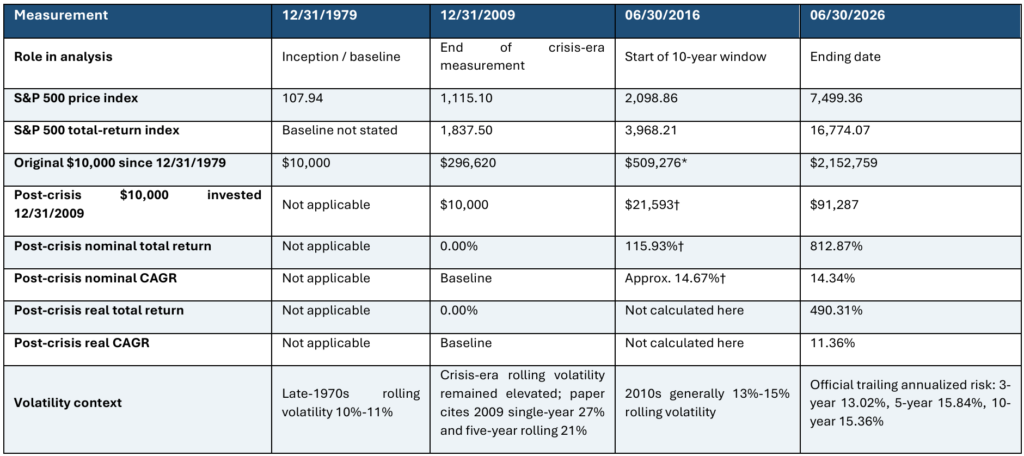
3 . Illustration of $10,000 Investments:

Scale of nominal compounding (dividends reinvested)
12/31/1979 original investment $ 10,000 █
12/31/2009 original investment $ 296,620 ███████
06/30/2026 post-crisis investment $ 91,287 ███
06/30/2026 original investment $ 2,152,759 ██████████████████████████████████████
4. Interpretation
The revised endpoint matters. December 31, 2008, captured the market in the middle of the financial
crisis, while December 31, 2009, captures both the collapse and the first substantial recovery year.
Measuring from 12/31/2009 therefore answers a different and cleaner question: how did the S&P 500
compound after the Great Financial Crisis period? The answer is striking—approximately 9.13 times the
original capital nominally and 5.90 times after inflation over 16.5 years.
This result should not obscure the path. The post-crisis era included the European sovereign-debt
scare, the 2018 selloff, the 2020 pandemic crash, the 2022 inflation-and-rate shock, and repeated
episodes of double-digit volatility. The compounding outcome depended on remaining invested,
reinvesting dividends, and avoiding destructive market-timing decisions.
